
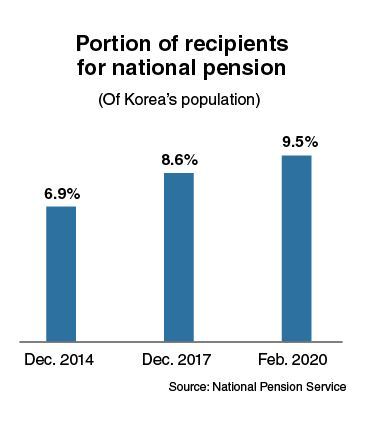
More than six in ten recipients of Korea’s old-age pension under the National Pension Service receive less than 600,000 won per month, according to May 2026 data released by the pension fund. Of the 6.605 million beneficiaries drawing old-age pensions last month, 62.4% (approximately 4.123 million people) fell below the 600,000-won threshold.
The largest share—2.224 million pensioners—received between 200,000 and 400,000 won each month. Another 1.396 million received 400,000 to 600,000 won, while just over 50,000 received less than 200,000 won. Expanding the range to under 1 million won covers 82.7% of pensioners (5.464 million), while those receiving 2 million won or more account for roughly 2% (129,265 people).
Excluding special pensions and split pensions, the average monthly old-age pension stood at 705,370 won. Special pensions—granted under transitional provisions to those with shorter enrollment opportunities—and split pensions—allocated to former spouses after divorce—averaged 258,899 won and 274,030 won per month, respectively.
Length of participation in the pension system strongly influences benefit levels. Pensioners with 20 years or more of contributions received an average of 1,172,536 won per month, compared with 452,051 won for those with 10 to 19 years. However, individual payout amounts also reflect contributors’ earnings history and any reductions for early retirement or ongoing income.
Retirement planning specialists caution that National Pension benefits alone do not determine a household’s overall financial situation. Regular outlays for food, utilities, medical care, as well as any basic pension, corporate retirement pension, personal savings or rental income, should all be taken into account when considering a retiree’s monthly budget.